The rapid advancement of technology has transformed our daily lives, bringing unprecedented convenience and efficiency. However, this progress also poses significant challenges in terms of security and privacy. With the growing sophistication of cyber threats, traditional cybersecurity measures are proving insufficient. In response, artificial intelligence (AI) is increasingly being leveraged to strengthen defenses and enhance the efficacy of cybersecurity strategies. In this blog post, we will explore the intersection of AI and cybersecurity, and discuss how AI is transforming the way we protect our digital assets.
AI-powered threat detection and prevention
As organizations deploy more complex systems and applications, managing vulnerabilities becomes increasingly challenging. AI can streamline this process by automatically identifying vulnerabilities in software and infrastructure, prioritizing risks, and suggesting appropriate remediation measures.
For instance, AI-based vulnerability scanners can efficiently analyze large codebases to detect security flaws and suggest fixes, reducing the likelihood of exploitable vulnerabilities in production environments. AI can also assist in prioritizing which vulnerabilities require immediate attention based on factors such as their potential impact and the likelihood of exploitation.
Automating incident response
In the face of a cyberattack, rapid response is crucial to minimizing damage. AI can accelerate incident response by automating the analysis of security incidents and providing actionable insights to security teams.
For example, AI-powered Security Information and Event Management (SIEM) systems can ingest and analyze large volumes of security logs and alerts, identifying patterns and correlating events to pinpoint the root cause of a security incident. This enables security teams to quickly address issues and mitigate potential damage.
Enhancing security through AI-driven authentication
AI can improve the security of authentication mechanisms by incorporating biometric data and behavioral analytics. For instance, AI-powered facial recognition systems can provide a more secure alternative to traditional authentication methods such as passwords and PINs. Similarly, AI-based behavioral biometrics can analyze a user’s typing patterns, mouse movements, and other behavioral characteristics to verify their identity and detect potential fraud.
Tackling the evolving threat landscape with AI
While AI holds great promise in enhancing cybersecurity, it is essential to recognize that cybercriminals are also employing AI to develop more sophisticated attack methods. This evolving threat landscape underscores the need for organizations to continually invest in AI-driven security solutions and stay ahead of potential risks.
Conclusion
As the intersection of AI and cybersecurity continues to grow, it is clear that AI has the potential to revolutionize the way we approach digital security. By harnessing the power of AI, organizations can detect and respond to threats more effectively, manage vulnerabilities, and enhance authentication mechanisms. However, as cybercriminals become more adept at leveraging AI, it is crucial for organizations to remain vigilant and adapt to the ever-changing threat landscape. By staying informed and investing in AI-driven security solutions, organizations can fortify their defenses and safeguard their digital assets.
Threat modeling is a process used to identify and prioritize potential threats to a system or organization. By understanding the potential risks and vulnerabilities, organizations can take steps to mitigate or prevent them.
One popular method for threat modeling is the STRIDE approach, which stands for Spoofing, Tampering, Repudiation, Information disclosure, Denial of service, and Elevation of privilege. This method helps organizations identify potential threats and understand the impact they could have on the system or organization.
Another popular method is the PASTA approach, which stands for Process for Attack Simulation and Threat Analysis, it is a structured approach to identify, quantify, and prioritize threats. It begins with understanding the architecture of the system and identifying the assets that need to be protected. The next step is to identify the potential attackers and their motivations. Finally, the organization simulates attacks and evaluates the impact they could have on the system.
Threat Modeling Process
Identify the valuable assets that the system must protect
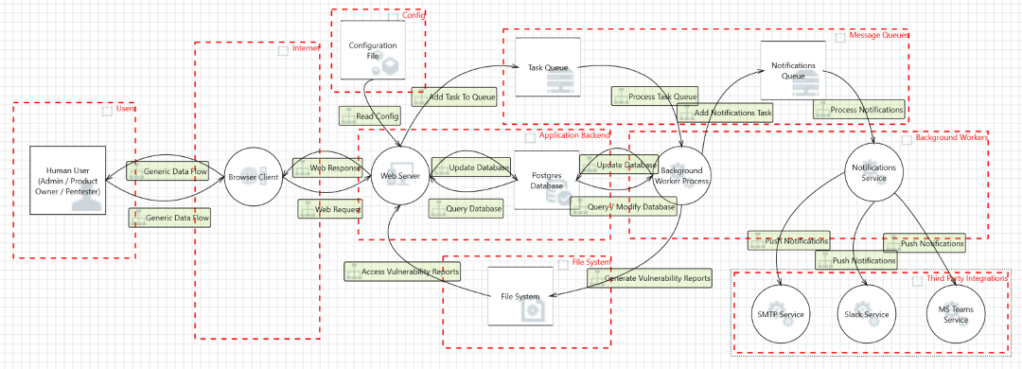
Use tables and the Microsoft threat modeling tool to document the architecture of the application, including subsystems, trust boundaries, and data flow
Decompose the architecture of the application, including the underlying network and host infrastructure design, to create a security profile for the application; the aim of the security profile is to uncover vulnerabilities in the design, implementation, or deployment configuration of the application
Keeping the goals of an attacker in mind, and with knowledge of the architecture and potential vulnerabilities of the application, identify the threats that could affect the application
Document each threat using a common threat template that defines a core set of attributes to capture for each threat
Rate the threats to prioritize and address the most significant threats first; the rating process weighs the probability of the threat against damage that could result should an attack occur; it might turn out that certain threats do not warrant any action when you compare the risk posed by the threat with the resulting mitigation costs
Defect Dojo – Threat Modeling Example
Defect Dojo is an open-source vulnerability management tool that helps organizations track and manage security vulnerabilities. It provides a centralized platform for managing and reporting on vulnerabilities, tracking remediation efforts, and managing penetration testing engagements. Defect Dojo allows organizations to import vulnerabilities from a variety of sources, including scanners and manual findings, and provides a number of features for prioritizing and managing vulnerabilities, including risk scoring and reporting. Additionally, it offers integration with other tools such as Jira, Slack, and GitLab. Defect Dojo is designed to be easy to use and customizable, making it a popular choice for organizations of all sizes.
Step 1 – Identify Assets
Products Information – Stores information related to different products that would undergo security testing. This includes information of the product and its features.
Vulnerability Findings – Stores information about the vulnerabilities found in products during security testing.
User Credentials – Stores information of user authentication credentials and includes usernames and passwords.
Test Results – Stores success and failure scenarios of security tests performed on a product. It also includes information about false positives.
Vulnerability Reports – All true positive findings of a security testing on a product exported as a report and stored as a pdf / word / excel on the server.
Database Credentials – The web application, to access database stores credentials
Web Server – The host and the application server that runs the web application
Application Notification Configurations – Application sends notifications to users through Email, Slack, MS Teams and other channels for which it stores the API keys for each of the integrations.
API Endpoints – API Endpoints to serve data to requests from the web UI or the browser.
Web UI – An interface for users to interact with the application.
Step 2 – Create an architecture diagram
Microsoft Threat Modeling Tool is a tool that helps organizations identify and mitigate potential security threats by creating detailed architecture diagrams of their systems. It provides several templates for different systems and allows for customization, it also allows for automated threat analysis and prioritization of identified vulnerabilities. It also generates a report that can be used to communicate the security posture of the system to stakeholders and management. The tool helps organizations design and plan secure systems.
Step 3 – Document the security profile
A security profile is a set of security measures and controls that an organization puts in place to protect its assets and data. These measures may include things like firewalls, intrusion detection systems, encryption, and access controls. A security profile can also include policies and procedures for incident response, disaster recovery, and employee training. The goal of a security profile is to provide a comprehensive approach to security that covers all the critical areas of an organization’s operations. It is important for organizations to regularly review and update their security profiles to ensure that they are aligned with the latest security best practices and threats.
Few examples are as shown below –
Categories
Threat Considerations
Input validation
Is all input data validated? Could an attacker inject commands or malicious data into the application? Is data validated as it is passed between separate trust boundaries (by the recipient entry point)? Can data in the database be trusted?
Authentication
Are credentials secured if they are passed over the network? Are strong account policies used? Are strong passwords enforced? Are certificates being used? Are password verifiers (using one-way hashes) used for user passwords?
Authorization
What gatekeepers are used at the entry points of the application? How is authorization enforced at the database? Is a defense in depth strategy used? Do you fail securely and only allow access upon successful confirmation of credentials?
Configuration management
What administration interfaces does the application support? How are they secured? How is remote administration secured? What configuration stores are used and how are they secured?
Sensitive data
What sensitive data is handled by the application? How is it secured over the network and in persistent stores? What type of encryption is used and how are encryption keys secured?
step 4 – identify threats
Threat identification can take any of the below mentioned forms –
Stride Approach
The STRIDE approach is a method used in threat modeling to identify and prioritize potential security threats. It stands for Spoofing, Tampering, Repudiation, Information disclosure, Denial of service, and Elevation of privilege. This method helps organizations identify potential threats and understand the impact they could have on the system or organization. Each category of the acronym represents a different type of threat, such as Spoofing for impersonation, Tampering for unauthorized modification, Repudiation for denying actions, Information disclosure for unauthorized access, Denial of service for disrupting availability and Elevation of privilege for unauthorized actions. By identifying potential threats in each category, organizations can take steps to mitigate or prevent them, helping to protect their assets and maintain the trust of their customers.
Property
Threat Definition
Examples
Mitigations
Tampering
Potential Persistent Cross-Site Scripting
An adversary can store malicious javascript code into the database and can obtain the cookie values of logged in users who visit the affected pageAn adversary can deface the application making it look like a login page thereby obtaining user credentials
Perform input validationContext based output encoding (HTML, JavaScript, CSS and others)HTML sanitizationSet cookie attributes like secure and HttpOnly
Example of Tampering attack using STRIDE approach
categorized threat lists Approach
Categorized Threat Lists (CTL) is a method of organizing and prioritizing potential security threats based on their likelihood and impact. This method creates a list of threats that are grouped into different categories, such as high, medium, or low risk. This allows organizations to prioritize their efforts and focus on the most critical threats first. Categorized Threat Lists are often used in conjunction with other threat modeling methods, such as STRIDE or PASTA, to provide a more comprehensive approach to identifying and mitigating security risks. These lists can also be used to track the progress of remediation efforts and report on the current state of an organization’s security posture. CTLs are also useful for communication and education of the threat landscape for stakeholders, allowing them to understand risks and take appropriate action.
Name
Description
Countermeasures
Authentication
Attacks on authentication is usually known as Spoofing – an attacker tries to impersonate another user thereby leading to unauthorized disclosure of information. Brute force method to break authentication is one of the most common methods to login as another user. In addition, stolen credentials, broken authentication and default credentials allows attackers to not only gain access to other users, but also to administrative interfaces
Implement strong authentication mechanisms and ensure strong password policyImplement strong password hashing to avoid password leakageEnforce rate limiting, Captcha and Multi Factor authentication to prevent brute force attacksEnsure to use certificates to prove the authenticity of sender and receiver
Example of Authentication attack using Categorized Threat List approach
Relevant attack patterns approach
Relevant attack patterns are specific tactics, techniques and procedures used by attackers to exploit vulnerabilities in a system or organization. They are identified through threat modeling or threat intelligence and are specific to the environment of the organization. By identifying these attack patterns, security teams can focus their efforts on the most at-risk areas and develop effective countermeasures. They also can be used to train employees and test incident response plans.
Goal: Exploit the potential SQL injection vulnerability to compromise the confidentiality and integrity of data in the database
Precondition: Attacker provides inputs which are used to build an SQL query without validation
Attack:1. Identify user input parameters on the target system susceptible to SQL injection 2. Construct an input value that has some malicious SQL queries 3. Send a request with the malicious input to the application leading to execution of malicious queries on the database
Postcondition: Target system executes the malicious SQL queries on the database
Example of SQL Injection using Relevant Attack Pattern approach
Goal: 1. Potential Elevation of Privilege Using Remote Code Execution
Precondition: Web server processes malicious files from the file system without validation
Attack: 1. Identify the file processing feature of the application 2. Construct a malicious file that executes when processed by the web server 3. Upload the malicious file to the file system 4. Trigger the file processing feature to read the malicious file thereby executing commands remotely
Postcondition: Target system executes the commands leading to Remote Code Execution
Example of Privilege Escalation using Relevant Attack Pattern approach
Attack Trees Approach
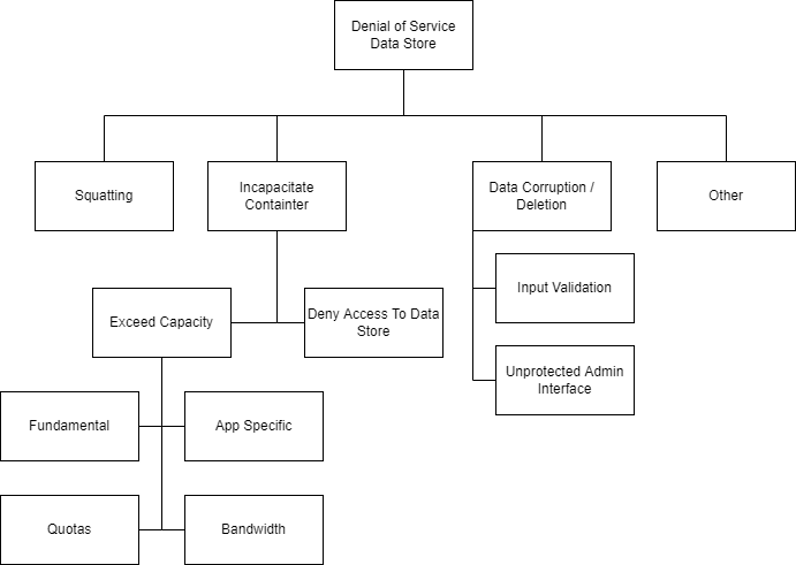
Attack trees are a method of visualizing and analyzing potential attack paths against a system or organization. They are a type of decision tree that starts with a high-level attack goal and branches out into specific tactics, techniques and procedures (TTPs) used to achieve that goal. They are useful for identifying potential vulnerabilities and understanding the potential impact of different types of attacks, and also for evaluating the effectiveness of different security controls and countermeasures.
Example of Denial of Service to Data Store using Attack Trees Approach
Input parameter tampered with malicious JavaScript
Countermeasures
Output Encoding, HTML Sanitization, Input validation
Example of a documented threat
Threat Description
Authentication Attacks
Threat target
Application Authentication Mechanism
Risk
Medium
Attack techniques
Brute Force Attacks, Stolen Credentials
Countermeasures
Protection against brute force attacks
Example of a documented threat
Conclusion
Threat modeling can be an ongoing process, with organizations regularly reviewing and updating their models as new threats emerge. One of the main benefits of threat modeling is that it helps organizations focus their security efforts on the areas that are most at risk. By identifying potential threats early on, organizations can take steps to prevent them from happening.
In addition to identifying and preventing threats, threat modeling can also help organizations understand the trade-offs they may need to make between security and functionality. It can also help organizations identify areas where they may need to invest in new technologies or processes to better protect their systems.
In summary, threat modeling is an important step in ensuring the security of a system or organization. By identifying and prioritizing potential threats, organizations can take steps to mitigate or prevent them, helping to protect their assets and maintain the trust of their customers.
Vulnerabilities in dependencies can be a silent threat to the security of your software. Dependencies are external libraries, frameworks, and other software components that your code relies on to function. They can be included in your codebase through package managers, or added manually. While they can save developers time and effort by providing pre-built functionality, they can also introduce security risks if not properly managed.
When a vulnerability is discovered in a dependency, attackers can exploit it to gain access to your system, steal sensitive data, or perform other malicious actions. This is especially concerning when the dependency is widely used, as attackers can target multiple systems with the same exploit.
One example of this is the recent vulnerability discovered in the popular JavaScript library, jQuery. The vulnerability, known as jQuery-XSS, allows attackers to inject malicious code into web pages that use the library. This vulnerability was present in versions of jQuery prior to 3.0.0 and affected thousands of websites that used the library.
Another example is the event-stream incident where a dependency was compromised by an attacker and a malicious version of the package was published to npm (node package manager) which was later being used by multiple projects.
To protect your software from vulnerabilities in dependencies, it is important to keep them up to date and to monitor for security updates. Many package managers, such as npm and pip, have built-in functionality for automatically updating dependencies. Additionally, using tools like Snyk, OWASP Dependency-Check, or WhiteSource can help you identify and fix vulnerabilities in your dependencies.
It is also important to keep track of which dependencies are being used in your codebase and to review their security track record. This can be done by keeping a list of dependencies and their versions, and regularly checking for known vulnerabilities. Additionally, it is a good practice to avoid using dependencies with known vulnerabilities or with a poor security track record.
In addition to these best practices, it is also important to keep a close eye on the supply chain and make sure that the source code and the libraries you use are from trusted sources.
In conclusion, vulnerabilities in dependencies can be a silent threat to the security of your software. By keeping dependencies up to date, monitoring for security updates, and keeping track of which dependencies are being used in your codebase, you can protect your software from these potential vulnerabilities. It is important to stay vigilant and to not overlook the security of your dependencies, as they can make or break the security of your entire system.
When it comes to developing software, it’s important to keep certain information secure. This includes things like passwords, API keys, and other sensitive data that should not be shared publicly. However, it’s all too easy for this type of information to end up in the source code, either by accident or due to a lack of proper security practices.
One way that this can happen is through the use of hard-coded credentials. This means that a developer has included a password or other sensitive information directly in the source code, rather than storing it in a separate configuration file or environment variable. This is a major security risk, as it means that anyone who has access to the source code can easily see and potentially use this sensitive information.
Another issue is the use of secrets in source control systems. Many developers use version control systems, such as Git, to manage their source code. However, if these systems are not configured properly, it’s possible for sensitive information to be committed to the repository and shared publicly.
To prevent these types of security issues, it’s important to follow best practices when it comes to managing credentials and secrets in your source code. This includes things like:
Storing sensitive information in separate configuration files or environment variables, rather than hard-coding it in the source code.
Using password management tools to generate and store strong, unique passwords.
Configuring your version control system to ignore sensitive files or directories, so that they are not committed to the repository.
Regularly rotating and updating passwords and other sensitive information.
Use source code secrets detection tools to automatically scan and identify sensitive information, such as passwords and tokens, in the source code
Challenges in managing secrets
False positives: The tools used for source code secrets detection can sometimes generate false positives, which can be time-consuming and difficult to manage, especially for large codebases.
False negatives: The tools may not be able to detect all instances of sensitive information, leading to false negatives, which can leave vulnerabilities in the code.
Scalability: As the codebase grows, the tools need to be able to scale with it, in order to be able to detect secrets in a reasonable time.
Complexity: Different projects have different requirements and complexity levels, and some tools may not be able to handle certain types of code or programming languages.
Maintenance: It’s important to keep the tools updated and configured properly to ensure they are effective.
Evolving threats: As attackers’ techniques evolve, the tools need to be updated to keep up with new types of secrets that could be embedded in the code.
Human error: Developers may not be aware of all the sensitive data they are handling and may inadvertently include it in the code.
Solution
Vigilant Fiesta is a source code secrets detection tool that utilizes the power of Trufflehog, which not only detects secrets such as passwords, keys, and tokens in source code, but also has a feature for verifying them to reduce false positives. Trufflehog is a tool that uses a combination of regular expressions and entropy analysis to identify sensitive information in code repositories.
The tool can be configured to scan specific file types and directories, and can be integrated with popular version control systems such as Git and SVN. Additionally, it has a feature to verify the secrets that are detected and if they are found to be false positives, they can be tagged accordingly which reduces the number of false positives. This makes Vigilant Fiesta a powerful tool for identifying and mitigating the risk of secrets leaking in source code, while also reducing the burden of manual verification on the developer.
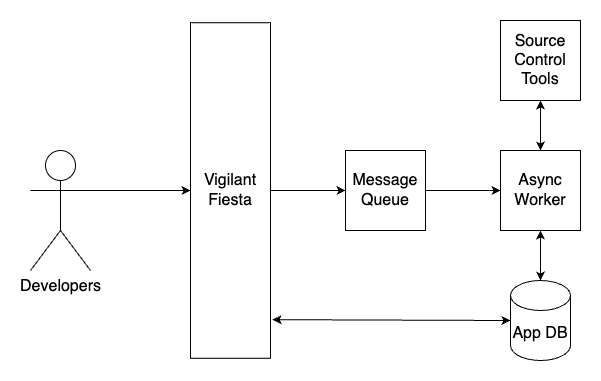
Architecture Diagram and Explanation:
Security professionals use the Vigilant Fiesta application to trigger scan on repositories.
If secrets are detected, an alert is triggered and sent to the appropriate team or individual (e.g. security team).
The alerted team or individual can verify findings to see if they are currently active
They then review the detected secrets and determines the appropriate action (e.g. removing the secrets from the source code, rotating passwords, etc.).
If necessary, the team or individual can also implement additional security measures to prevent similar issues from occurring in the future.
The team or individual can then create pull requests to the repository allowing the secrets to be removed from historical commits.
This architecture allows for automated detection of secrets in source code, as well as a process for handling and addressing any issues that are discovered. By implementing this type of system, organizations can help ensure that their source code is secure and that sensitive information is not accidentally shared publicly.
Remediation
Remediating secrets identified in source code involves taking steps to remove or secure the sensitive information. This can include:
Removing the secret from the code and replacing it with a placeholder or environment variable.
Storing the secret in a secure location, such as a password manager or a secure storage service, and ensuring that only authorized personnel have access to it.
Implementing access controls and logging to track who has accessed the secret and when.
Regularly reviewing and rotating secrets to ensure that they are still secure and have not been compromised.
Educating developers and other personnel on the importance of keeping secrets secure and providing them with guidelines for handling sensitive information in code.
Continuously monitoring the source code for secrets and implementing automated tools to detect secrets in the future.
By following these steps, you can effectively remediate secrets identified in source code, keeping your sensitive information secure and minimizing the risk of data breaches
Pro Tip – BFG Repo-Cleaner
BFG Repo-Cleaner is a tool that can be used to remove secrets from Git repositories. It works by searching for files that match certain patterns, such as files containing the word “password,” and replacing them with a specified replacement value. This process can be used to remove secrets from a repository’s history, making it harder for someone to find and access the sensitive information.
To use BFG Repo-Cleaner, you will first need to download the tool and install it on your machine. Once you have it installed, you can use it to scan your repository and identify files that contain secrets. You can then specify a replacement value to use when removing the secrets. This can be a placeholder or an environment variable, depending on your needs.
For example, to use BFG-repo cleaner to remove secrets from a repository, you can run the following command in the terminal:
bfg --replace-text secrets.txt my-repo.git
Where ‘secrets.txt’ is the file containing the secrets that you want to remove and ‘my-repo.git’ is the repository that you want to clean up.
Please note that BFG Repo-Cleaner works by rewriting repository’s history so it’s best practice to backup the repository before using it. Also, if the repository is public, it’s best practice to create a new repository and push the cleaned history to it.
Overall, BFG Repo-Cleaner can be a powerful tool for removing secrets from Git repositories, making it harder for someone to find and access the sensitive information.




 Preetham Nagesh